See which platforms provide full coverage of the FIFA World Cup 2026.
Anúncios
There are moments when football stops being just a game and becomes a constant topic.
The FIFA World Cup 2026 is exactly that kind of event, one that starts taking up space even before it actually begins.
Anúncios
It shows up in conversations, comparisons, spontaneous predictions, and that natural curiosity about how everything will work this time.
And it’s no small thing: more teams, more matches, three host countries, and a format that completely changes the rhythm of the competition.
Anúncios
That’s why having a clear overview from the start helps you enjoy every phase more calmly, without getting lost in the middle of so much information.
👉 This content is informational and aims to guide the reader. It does not offer live streams nor replace the official platforms responsible for broadcasting the matches.
How to Watch the Matches Officially
When it comes to watching the FIFA World Cup 2026, the most common mistake is searching for links without understanding the landscape. The key point here is simple: broadcasting rights are regional.
Instead of thinking only about “which app,” it makes more sense to think about where you’ll be during the match and how you usually watch football in your daily life.
In practical terms, the official platforms are distributed as follows:
- United States: FOX Sports App, Peacock, FuboTV, YouTube TV
- Canada: CTV App
- Mexico: TUDN App, ViX
- Europe: BBC iPlayer, ITVX, ARD Mediathek
- Africa: SuperSport App (Sub-Saharan Africa), beIN Connect (North Africa)
- Middle East: beIN Connect
- Asia: Disney+ Hotstar (selected markets)
- Oceania: SBS On Demand
As a complement, there is also FIFA+, the official global platform.

It does not carry all matches live, but it works as a true information hub, offering behind-the-scenes access, exclusive interviews, institutional content, and official updates related to the FIFA World Cup 2026.
The Format that Transforms the Competition
The FIFA World Cup 2026 doesn’t just change in size. It changes the entire logic of the tournament.
For the first time, 48 teams will compete. That means more countries, more playing styles, and more stories unfolding at the same time.
The format is organized into 12 groups of 4 teams. Each team plays three matches in the opening phase, but with one important detail: there is almost no margin for error.
The top two teams from each group advance, along with the 8 best third-placed teams. This creates a knockout stage with 32 teams, something entirely new in World Cups.
In practice, the tournament becomes more intense:
- fewer “procedural” matches
- more decisions right from the start
- knockout rounds beginning earlier
With this format, every round matters. An early slip can completely change a team’s path.
For fans, that means more excitement spread throughout the entire competition.
Initial Groups and Participating Countries
Before diving into the matchups, it’s worth understanding how everything begins.
The group stage brings together the qualified teams and structures the tournament from the opening whistle, defining paths, crossovers, and potential surprises.
This is where the initial groups take shape, participating countries step onto the stage, and every detail starts influencing the direction of the competition.
| Group | Confirmed teams | Playoff |
|---|---|---|
| Group A | Mexico · South Korea · South Africa | DEN / MKD / CZE / IRL |
| Group B | Canada · Switzerland · Qatar | ITA / WAL / NIR / BIH |
| Group C | Brazil · Morocco · Haiti · Scotland | — |
| Group D | United States · Australia · Paraguay | TUR / ROU / SVK / KOS |
| Group E | Germany · Ecuador · Ivory Coast · Curaçao | — |
| Group F | Netherlands · Japan · Tunisia | POL / UKR / SWE / ALB |
| Group G | Belgium · Iran · Egypt · New Zealand | — |
| Group H | Spain · Uruguay · Saudi Arabia · Cape Verde | — |
| Group I | France · Senegal · Norway | IRQ / BOL / SUR |
| Group J | Argentina · Austria · Algeria · Jordan | — |
| Group K | Portugal · Colombia · Uzbekistan | NCL / JAM / COD |
| Group L | England · Croatia · Ghana · Panama | — |
The abbreviations represent teams still competing in the play-offs. The winner of each play-off joins the indicated group and completes the bracket.
Where the World Cup Will be Played
The FIFA World Cup 2026 will be co-hosted by the United States, Mexico, and Canada, something unprecedented in the tournament’s history.
In total, there will be 16 host cities, with most matches taking place on U.S. soil.
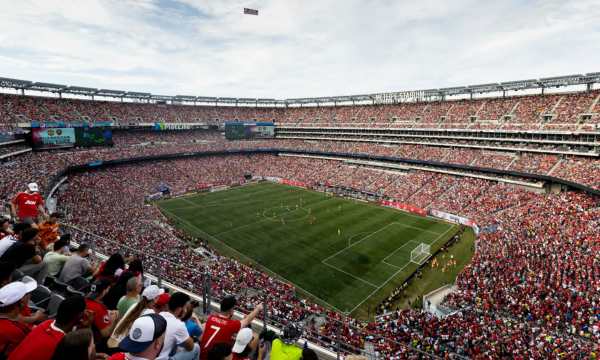
The opening match is scheduled for June 11, 2026, at the legendary Estadio Azteca, while the final will be played on July 19, 2026, at MetLife Stadium in New York/New Jersey.
Some important points about this distribution:
- The United States hosts around 60 matches
- Mexico and Canada host approximately 10 matches each
- Most stadiums are modern and high-capacity
This distribution creates logistical challenges, such as long travel distances and climate differences, but it also expands the tournament’s reach and its connection with different audiences.
The Details that Make this Edition Unique
There are several reasons why the FIFA World Cup 2026 is considered a historic edition.
Beyond the 48 teams and 104 matches, the tournament introduces important practical changes, such as:
- Fully digital tickets, with centralized access, mobile validation, and less bureaucracy on match day
- Heavy use of official apps, concentrating alerts, real-time information, fan services, and exclusive content
- Greater attention to time zones and location, since matches take place in different cities and countries, requiring planning to avoid missing key kick-off times
The combination of global scale and technology makes following the FIFA World Cup 2026 unlike anything we’ve seen before.
Predictions: Who has the Best Chance to Win?
Predictions are never certainty, but some names stand out more strongly when we look at rankings, squad depth, and recent form.
Spain, England, and France often appear among the favorites, thanks to deep squads and consistency in major tournaments.
Brazil and Argentina remain natural forces, even while going through tactical adjustments during the cycle.
Other teams like the Netherlands, Germany, and Portugal also have real potential to challenge, depending on the draw and physical preparation.
With a heavier calendar and decisive matches from the very beginning, the FIFA World Cup 2026 promises surprises.
In the end, the World Cup is built like this: matches that stop the day, debates that cross generations, that good kind of anxiety before kick-off, and narratives that are born in every round.
It’s an event that happens on the pitch, but also in conversations, expectations, and the small rituals of those who follow it.


